
Everyone’s Job, No One’s Responsibility: Human Trafficking as a Governance Failure

Updated: May 20
By Rachel French, an MPA student from the University of South Florida.
(This article was originally printed in the Spring 2026 edition of our print magazine. To see the entire magazine, click here.)
Introduction
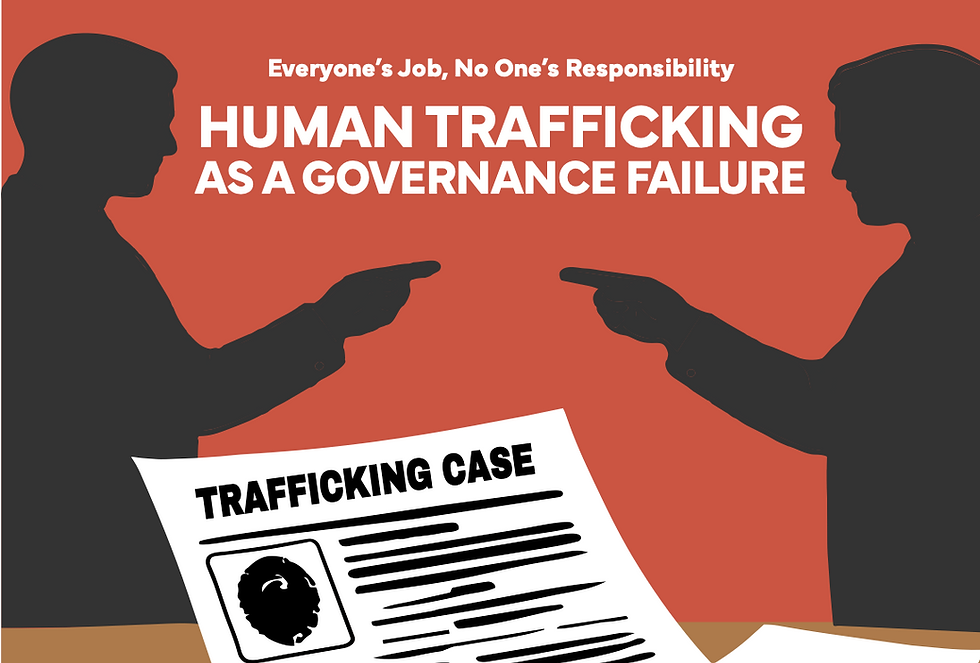
How does exploitation persist inside some of the world’s strongest democracies? Not for lack of laws, task forces, or political commitment, but because responsibility is divided. In many developed countries, anti-trafficking governance is dispersed across immigration agencies, labor regulators, prosecutors, and social service providers. Rather than operating through a single centralized hub, these systems rely on coordination across institutions designed to function independently. When authority is fragmented, accountability becomes blurred and exploitation can persist within otherwise robust legal frameworks.
Human Trafficking and Institutional Blind Spots
Per the United States Department of Justice (DOJ), “Human Trafficking is a crime involving the exploitation of a person for labor, services, or commercial sex” (U.S. Department of Justice, n.d.). Human trafficking is facilitated by a range of structural and individual vulnerabilities that increase susceptibility to exploitation. Structural conditions such as poverty, housing instability, migration status, and displacement create environments in which individuals may lack access to protective institutions or stable support systems. In particular, migration status can complicate interactions with immigration authorities and labor regulators, leaving some individuals outside the reach of systems designed to identify exploitation or provide protection. At the individual level, prior involvement in foster care, experiences of abuse or neglect, and substance dependence can further heighten risk by weakening social and economic safeguards. Certain populations, including children, particularly adolescent girls, as well as LGBTQ+ individuals, people of color, and Indigenous communities, face disproportionate vulnerability due to systemic discrimination and social marginalization. For children and youth, responsibility for protection is often concentrated within child welfare systems, which may limit the ability of other institutions, such as labor inspectors or immigration authorities, to identify exploitation when it occurs outside traditional child protection contexts.
Traffickers strategically exploit these layered vulnerabilities to establish and maintain control. Exploitation frequently begins not through overt physical force, but through coercion, manipulation, and psychological abuse. Perpetrators may offer financial assistance, debt relief, housing, or romantic partnership to cultivate dependence and trust before transitioning to exploitative arrangements. These forms of control can be difficult for institutions to detect when exploitation is embedded within family relationships, informal employment, or migration arrangements that fall between the jurisdiction of multiple regulatory systems. This gradual process underscores that trafficking is often sustained through relational and economic control rather than immediate violence, complicating identification and intervention efforts.
Understanding trafficking as a process of coercion and vulnerability is necessary but insufficient. The persistence of exploitation in developed democracies depends not only on individual perpetrators and victim vulnerabilities, but also on how institutions are structured to recognize, categorize, and respond to harm.
Human Trafficking Hot Spots
Human trafficking often manifests within legally regulated industries, including construction, agriculture, hospitality, food services, domestic labor, and spa services. Increasingly, recruitment and coercion are facilitated through digital platforms and social media. These sectors share a common feature: they operate at the intersection of labor regulation, immigration oversight, and criminal enforcement. Because oversight authority is divided among separate institutions, exploitation can be categorized as a labor infraction, an immigration irregularity, or a criminal offense depending on which agency first encounters it. This categorization process reflects governance structure as much as individual wrongdoing.
Comparative Governance
The United Kingdom has adopted a centralized legislative and referral framework through the Modern Slavery Act of 2015, which consolidates trafficking and slavery offenses into a single statutory regime and establishes national oversight mechanisms (UK Government, 2015). Complementing this legislative framework is the National Referral Mechanism (NRM), a centralized system designed to identify potential victims and coordinate support services across England and Wales (UK Government, 2023). Together, these mechanisms create a formal national entry point for victim identification and data collection, placing accountability within a centralized administrative structure. The United Kingdom’s national anti-trafficking strategies and cross-agency initiatives aim to improve victim identification and strengthen enforcement efforts.
Germany, by contrast, embeds trafficking offenses within its federal Criminal Code rather than consolidating them into a standalone statute, and enforcement responsibilities are distributed across the Länder (states). While national coordination efforts and action plans exist, victim identification and service provision vary regionally, and there is no single unified national referral mechanism comparable to the UK’s NRM. Germany maintains federal and state-level initiatives focused on combating human trafficking and supporting victims, reflecting a governmental commitment to addressing the issue.
The UK reflects a more centralized accountability model, whereas Germany demonstrates how federal fragmentation can diffuse responsibility across multiple levels of government. These contrasting structures do not suggest that one country eliminates trafficking while the other enables it. Rather, they illustrate how governance design shapes the trajectory of suspected exploitation. In centralized systems, suspicion is more likely to enter a dedicated trafficking-specific pathway. In decentralized systems, cases may remain within the regulatory domain of the first institution that encounters them. The distinction lies not in political will, but in institutional architecture.
Germany Scenario - Driven By Governance
Background: A 15-year-old girl from Eastern Europe relocates with extended family to Germany for seasonal agricultural work. She is undocumented in practice (though EU movement rules complicate formal categorization), speaks limited German, and is withdrawn from school. Seasonal migration arrangements and informal recruitment channels can allow minors to move across borders with limited documentation oversight, particularly when employment occurs within family or subcontracted labor networks. She works long hours in food processing, receives no pay directly, and is controlled by a relative who claims to manage her earnings. The work occurs within an informal labor environment where oversight by labor authorities is limited and employment relationships are difficult to verify. She is not visibly restrained or reporting any violence, residing with family and not interacting regularly with teachers or social workers. Because responsibility for monitoring minors may rest primarily with youth welfare authorities, while labor oversight and immigration monitoring occur in separate institutional spheres, the situation may remain unnoticed until another regulatory body encounters irregularities.
Scenario: When a labor inspector visits the food processing site, nothing immediately signals a criminal offense. What stands out instead are administrative irregularities: incomplete pay records, unusually long hours, and unclear documentation regarding who is responsible for the minor’s employment. These are the kinds of issues labor inspectors are trained to identify and address within the scope of labor law.
As a result, the situation is initially processed as a labor compliance issue. The inspector’s authority is grounded in enforcing wage regulations, working conditions, and employment documentation; not in making determinations about trafficking. While elements of exploitation may be present, they are not yet framed within a criminal context.
To formally classify the situation as human trafficking, a higher evidentiary threshold must be met. This typically requires demonstrating coercion, abuse of vulnerability, or clear exploitative intent under criminal law standards. At the point of inspection, these elements may not be immediately provable through administrative findings alone.
Escalating the case beyond a labor violation requires coordination across multiple institutions, including law enforcement, prosecutors, and youth welfare authorities. Because these responsibilities are distributed across Länder (state) and local jurisdictions, there is no single authority responsible for advancing the case. Each step depends on interagency communication and discretionary judgment.
In the absence of a centralized referral mechanism triggered by suspicion alone, the case may remain within the regulatory domain in which it was first identified. Without a formalized pathway to transition from administrative concern to coordinated trafficking response, the situation risks stalling.
As a result, what may constitute exploitation is addressed as a labor irregularity. Without clear institutional handoff or unified accountability, the case may never fully transition into a trafficking investigation or victim protection process.
UK Scenario - Driven By Governance
Background: A 15-year-old girl from Eastern Europe relocates with extended family to the United Kingdom for seasonal agricultural work. Although her immigration status is unclear in practice, complicated by shifting post-Brexit movement rules, she lacks formal documentation and speaks limited English. Shortly after arrival, she is withdrawn from school. She works long hours in food processing, does not receive wages directly, and is told by a relative that her earnings are being managed on her behalf. She is not visibly restrained or reporting any violence, resides with family members, and has minimal interaction with teachers or social workers.
Scenario: When a labor inspector encounters similar irregularities at a food processing site in the United Kingdom, the initial observations may appear comparable: excessive working hours, lack of direct payment, and unclear guardianship arrangements. However, the institutional response unfolds differently once indicators of potential exploitation are recognized. Rather than remaining confined within labor enforcement, suspicion alone is sufficient to trigger a trafficking-specific pathway through the National Referral Mechanism (NRM). The inspector, or another authorized first responder, can refer the case into this centralized system even without definitive proof of criminal wrongdoing.
Upon referral, the case is evaluated under an administrative ‘reasonable grounds’ standard. This threshold allows authorities to formally recognize an individual as a potential victim of trafficking based on indicators of exploitation, even if the evidentiary standard required for criminal prosecution has not yet been met.
Once entered into the NRM, the case becomes part of a centralized process for identification, documentation, and follow-up. This creates a structured pathway for assessment and ensures that the case does not remain isolated within a single regulatory domain.
For a minor, referral into the system also strengthens safeguarding measures and access to support services while the case is under review. Protection does not depend on the immediate success of a criminal investigation, but rather on the recognition of vulnerability and potential exploitation.
Even if the case does not ultimately result in prosecution, it is less likely to remain categorized solely as a labor violation. The governance structure provides a clear mechanism for transitioning suspicion into formal identification and coordinated response, reducing the likelihood that exploitation remains unaddressed.
Governance Design is Prevention
The comparison between Germany and the United Kingdom demonstrates that trafficking identification is not solely a function of criminal law strength, but of governance structure. When enforcement, victim services, labor oversight, and immigration regulation operate independently, escalation depends on interagency discretion rather than institutional mandate. Fragmented systems can inadvertently diffuse responsibility, allowing cases to stall within administrative categories. Centralized referral mechanisms, by contrast, create clearer pathways for suspicion to become formal identification, even before criminal thresholds are met.
Human trafficking persists in developed democracies not because vulnerabilities exist, but because institutional responses are often divided across bureaucratic boundaries. When accountability is dispersed, protection depends on coordination rather than structure. In that space between institutions, exploitation can endure, leaving victims more difficult to identify, delay access to protection, and create opportunities for perpetrators to exploit gaps in oversight and sustain cycles of trafficking. Ultimately, when it is everyone’s job but no one’s responsibility, exploitation can endure within the very systems meant to prevent it.


Comments