
Massacres Do Not Change People: How The Parsley Massacre is Remembered


Camila Polanco
The Parsley Massacre in 1937 was a racially-charged massacre where Dominican soldiers killed over twenty thousand Haitians alongside the Dajabon River, yet to this day, this mass killing remains largely unknown. Since the massacre, little has changed, and racial tensions have continuously risen between both countries. Yet, the collective memory of the Massacre by both Haitians and Dominicans differs significantly: While the Dominicans don’t concern themselves with a recollection of the events, the Haitians are forced to carry the mark of the massacre with them as victims. This phenomenon prompts the question: Why is the Parsley Massacre remembered in Haiti and not in the Dominican Republic? Existing theories, such as “collective memory,” proposed by Maurice Halbwachs, relate to the subconscious memory of a group of people being passed down from one generation to the next. Meanwhile, “sites of memory,” introduced by Pierre Nora, refer to specific places, objects, or concepts that are rich in historical significance and serve as collective memories for a community. Both of these theories can apply to this case. However, due to the differing national identities of both countries and the role political violence plays in nationalism in the Dominican Republic, the Massacre is well-remembered in Haiti and minimally recalled in the Dominican Republic. Gathering different perspectives is a vital step in understanding why the dynamic between both countries remains hostile and how the hostility negatively affects how the Massacre is currently remembered. To this end, Dominicans born and raised in the Dominican Republic, Dominicans born in Spain and the U.S., a Haitian-American, and a born and raised Haitian were all interviewed for this article to compare how historical narratives differ on both sides.
In the context of the Parsley Massacre, “collective memory” is the difference in representations of truth between Haitians and Dominicans. However, collective memory does not equate to historical accuracy and does not entirely explain the issue between Dominicans and Haitians. For example, Halbwachs mentions that collective memory is gained through interactions with family and kinship. He describes how people gain unlived memories through those around them. Ideologies and behaviors that are passed down between families explain why the Massacre is rarely talked about in the Dominican Republic.
Families pass down their memories and ideologies to one another, which enables cultures of silence to form. When applying Halbwachs’ theory of family or kinship to the phenomena of forgetting the Parsley Massacre in the Dominican Republic, it is easy to understand why there is this “culture of silence” in the country (Bishop and Fernandez 2017). If older generations were taught to never bring up trauma, future generations will be even less likely to break that cycle of silence. However, memory is not erased due to silence; instead, it is an indicator of remembrance. According to different interpretations of Halbwachs’ theory, “society itself seemingly ignores the memory of the event, yet the survivors bear the memory in their…silences” (Doolan, P. M. 2021: 4). While Haitians were targeted in the Massacre, dark-skinned Dominicans of Haitian descent were also killed. As a society, many Dominicans and Haitians block out or ignore the Massacre and other aspects of then-President Rafael Trujillo’s regime. Despite this, survivors are forced to remember the Massacre through learned behaviors, family tensions, and everyday life. This idea reinforces how “individuals, not societies, may experience amnesia” (Doolan, P. M. 2021: 4). Individuals may not know about the Massacre, but society holds onto the legacy of racism, nationalism, and anti-Haitianism that was left behind.
However, Nora highlights how memory and history are not synonyms. He describes how “memory has been promoted to the center of history,” which is important because it depicts and acknowledges both versions regarding historical events (Nora 1989: 24). He highlights how memory plays a role in history and that memory is just as important as history. Nora mentions how memory “remains in permanent evolution, open to the dialectic of remembering and forgetting” (Nora 1989: 8). Here Nora explains a key difference between memory and history: memory is subject to change while history is not. Many of his points, such as memory relying “entirely on the materiality of the trace [and] the immediacy of the recording,” relate to the Parsley Massacre because Trujillo delayed telling the truth and distorted the facts of the Massacre (Nora 1989: 13). Due to his manipulation, the memory of Dominicans was severely altered. Nora claims “history's goal and ambition is not to exalt but to annihilate what has in reality taken place” (Nora 1989: 9). When asking the question why societies remember or forget, analyzing history is crucial to getting an answer.
A superior image of a national identity was created by Trujillo through his acts of political violence and the absence of this violence from the collective memory. He left behind a legacy of nationalism and anti-Haitianism within Dominicans in an attempt to whiten the country. He was vocally proud of his European ancestry and demonized his African heritage. Trujillo had a political agenda behind the Massacre, other than expelling Haitians out of the country: he used the Massacre as a ploy not only to “make the Dominican Republic richer”. Since Haiti was economically better off, Trujillo knew that an attack this large would weaken Haiti. The Massacre was his opportunity to establish white-supremacist ideologies and expand his territory.
Trujillo justified his political violence against Haitians and relied on harmful rhetoric that promoted a stronger sense of nationalism in the country. He painted Haitians as barbaric to Dominican society (Baud 2005). His desire to “Dominicanize the country” instilled a sense of nationalism within the people. He used the Massacre as a way to establish Haitians as an enemy of Dominicans. There was significant “racial rhetoric,” and if Haitians—or more specifically their African heritage—could be deemed demonic; then, the Massacre can be “painted as just” (Bishop and Fernandez 2017). His tactics to rise politically and gain popularity allowed him to establish more control over the social narrative.
Trujillo’s tactics became fundamental to Dominican national identity; if Dominicans remembered the Massacre, it would challenge that identity. Trujillo exploited the nationalist ideology set by the “Dominican elite” to govern his people (Baud 2005: 127). Over time, the Massacre was written in history books but it was “more like a footnote” (Bishop and Fernandez 2017). Dominicans acknowledged the Massacre but could not tell the full history. Similarly, relating to Nora’s argument of memory relying on “the materiality of the trace,” failing to communicate events to a society has been shown to effectively create a false reality. Trujillo’s manipulation and disguise of the Massacre allowed him to assure a legacy of nationalism and spare him from the political violence he took part in. Many Dominicans were kept in the dark about the Massacre and also forced to partake in that “culture of silence” (Bishop and Fernandez 2017). With Dominican culture valorizing passed down lessons, many feel a certain way about talking about the past. They resist carrying the guilt and uncovering the trauma of Trujillo’s regime. They prefer remaining divided in order to continue exploiting Haitians in the Dominican Republic. Uncovering the truth on a cultural level would force people to reject who they are.
The Parsley Massacre severity raises multiple questions about why and how it seems forgotten or suppressed. Under Rafael Trujillo’s authoritarian regime, he ordered his soldiers to exterminate Haitians alongside the border of Haiti and the Dominican Republic. For generations people would cross over with ease between the countries and the two cultures would regularly intermix. Those with a dark complexion were targeted. However, Trujillo specifically targeted ethnic Haitians. In order to distinguish Haitians from Dominicans, soldiers would show a sprig of parsley and ask people to name the herb. Because of the linguistic differences between Haitian-Creole and Spanish when pronouncing the “r” in the word perejil, those who pronounced “perejil” differently would be killed. This strategy is how the Massacre got the name: the Parsley Massacre.
Preconceptions are tricky when analyzing history and memory. Assuming Dominicans chose not to remember the Massacre solely due to racist culture on the island, on a surface level, seems logical. However, unpacking the history and understanding the legacy and manipulation people underwent during Trujillo’s dictatorship helps explain this foggy point in history. After conducting interviews with a variety of Haitians and Dominicans, both sides were surprisingly similar. Out of the seven interviews conducted, only two people knew about the Parsley Massacre, and both were Dominican.
The legacy of anti-Haitianism Trujillo left behind was overtly present in the responses some Dominicans gave; especially of those born and raised in the Dominican Republic. Respondents used discriminatory language but followed up with “not to discriminate” statements. It was evident that racism and a lack of compassion towards Haitians are very normalized within Dominican society. One respondent laughed off important matters, and another used derogatory language to describe how they felt about Haitians, despite being born in Haiti. Curiously enough, one of the Haitian respondents described a disappointment in his country due to the current political crisis of the country and religious practices such as Vodun: a religion originating in West Africa. Similarly, another Haitian respondent expressed profound sadness about the current situation that Haiti finds itself in. Because of the Massacre, he is skeptical about the Dominican government and will never be happy with them. He has a deep love for Haiti and hopes that one day his son can visit and understand his love for Haiti. The responses suggest a strong anti-Haitian sentiment dominating Dominican society. As well as pain for Haiti’s mistreatment.
Trujillo also left a legacy of nationalism in the country. All of the Dominican individuals, when asked the question “What are your thoughts on the Dominican Republic or people?”, mentioned how it is the “best country in the Caribbean”. Responses claimed that the Dominican Republic makes people “feel very welcomed.” However, when asked the same question for Haiti, most responses coming from Dominicans were negative and anti-Haitian. Most Dominicans were not aware of the manipulation that occurred during Trujillo’s regime and how normalized Trujillo’s legacy is in their society. While almost none of the respondents knew about the Massacre, their testimonies helped understand the toxic Haitian and Dominican dynamic. Within Dominican society, people hold onto the Trujillo legacy. In both countries, there has been no space for the actual remembrance of the Massacre.
Currently, Haiti is at a critical point in its survival as a country. The nation is currently going through a gang war where “criminal gangs have tightened their grip…[and] multinational security” resulted in little social progress (Locked in Transition 2025). For many it can be “difficult for people to look back and ponder long ago horrors” (Haitians Times 2024). However, some individuals still carry the weight of the Massacre and seek justice for the victims. Many who lived the horrors of the Massacre fear setting foot in the Dominican Republic. The survivors of the Massacre will likely die without justice, as seen with the case of “Marcellus Jean [who] died at the age of 102” (Haitian Times 2024).
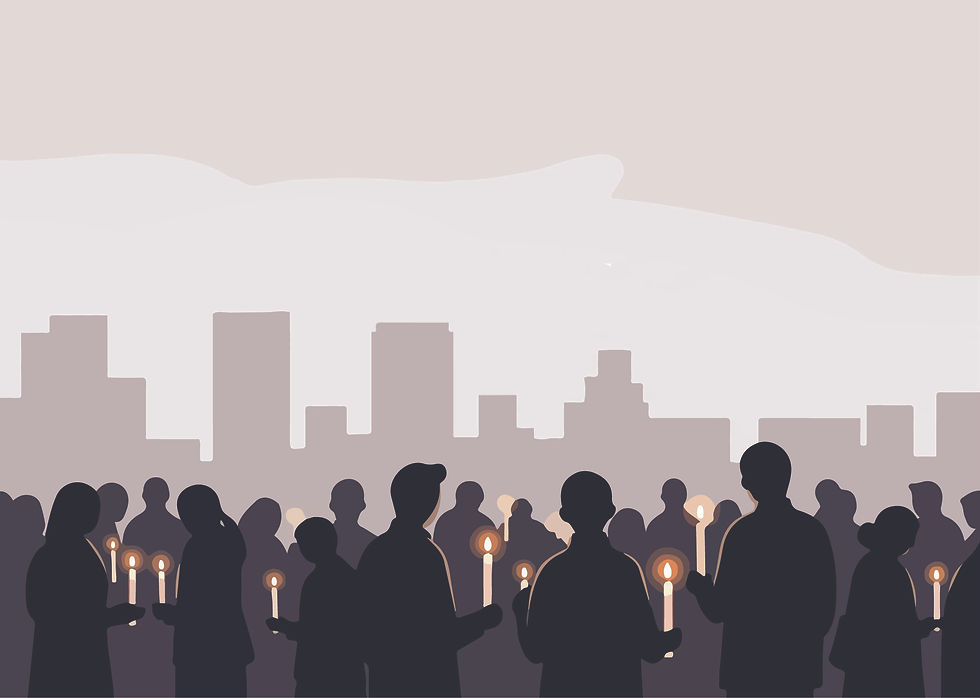
However, Dominicans are fighting against the “culture of silence” on the Island. Over “100,000 Dominican signatures ask[ed] for a truth and reconciliation” (Bishop and Fernandez 2017). An NPR podcast on this topic, for example, interviewed a Dominican woman feels guilty for her grandfather’s role in the Massacre and actively attempts to eliminate anti-Haitianism by working with nonprofit organizations that help Haitian immigrants (Bishop and Fernandez 2017). Another example of Dominicans commemorating the Massacre is a Dominican priest Regino Martinez who works on human rights cases in Dajabón. He led an event that “would break the silence of the last 75 years,” and spoke at a Catholic Church “as hundreds…lit candles and plodded toward the river ” (Fieser 2012). On the Haitian side of the river they noticed “the glow of candles” where people danced and “commemorated the event” (Fieser 2012). The Massacre is a weight both countries carry but cannot seem to acknowledge.
These developments also contradict aspects of “collective memory.” While the idea that “Individuals, not societies, may experience amnesia” was mentioned earlier, it is the opposite in this case (Doolan, P. M. 2021). While both societies hold onto remnants of the Massacre, the Massacre is almost ignored in both countries by society. Neither the government or society in both the Dominican Republic or Haiti give a place for the Massacre to be rightfully commemorated. Nevertheless, multiple individuals across both countries have struggled to one day receive justice for the victims of the Parsley Massacre.
Analyzing why Haitians remember The Parsley Massacre and why Dominicans do not is complex. Most of the secondary sources lack historical context and were about commemorating the seventy-fifth or eightieth year of the Massacre. However, journal articles helped contextualize the information in these secondary sources. The process of writing this article was difficult because when investigating historical events that are barely talked about, forgotten, and ignored it is hard to find adequate sources. Trujillo got away with the Massacre, manipulation, and instilling anti-Haitianism in the country. The fact that the Massacre is unremembered is the result of a tool that solidifies Haitian and Dominican dynamics to this day. Having conducted the research, it is crucial that no historical event goes unreported and that authoritarian manipulation of history is diminished. A regime forcefully creating different collective memories for a political agenda only allows for further discrimination, fostering hatred, and leads to extreme nationalist ideologies. Revealing this truth is the best and only way to heal the traumas of Trujillo’s regime and build a better nation with a foundation of truth and reconciliation.
(This article was originally printed in the Fall 2025 edition of our print magazine. To see the entire magazine, click here.)


Comments